
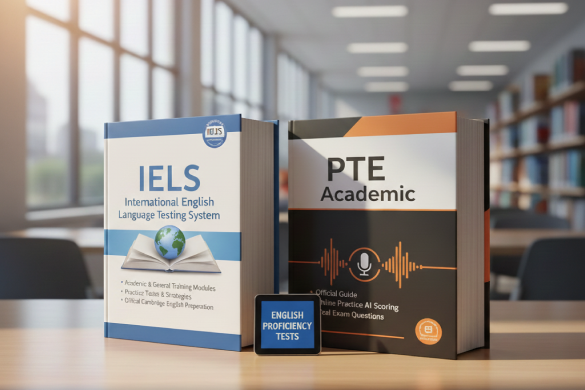
Studying abroad is no longer just a dream for Bangladeshi students — it’s an achievable reality for thousands every year. From the sunny campuses of Australia to the historic universities of the UK, from the innovation hubs of the USA to the welcoming, high-quality education system of Canada, one thing remains the same:
To study abroad, you must prove your English proficiency through IELTS or PTE Academic.
Yet every year at MABS International (Bangladesh), we notice a familiar pattern. Students walk in with big goals and strong academic backgrounds — but also the same fear:
High IELTS or PTE scores are not about luck. They are about strategy, consistency, and the right guidance.
In this blog, we share proven preparation tips that have helped students achieve IELTS 7+, 7.5, 8+ and PTE 65–79+ repeatedly. Whether your goal is Australia, UK, USA, Canada, Ireland, or New Zealand — this guide covers exam format, daily routines, time management, common mistakes, and exam-day strategies.1) Understand the Exam Format First (Most Overlooked Tip)
Success begins with clarity. If you don’t understand the structure and scoring, you’ll waste weeks practicing the wrong way.
IELTS Exam Structure
We often hear:
The problem is not effort — it’s unstructured effort.
High-Scorer Routine (6 Days/Week)
Morning (60–90 min)
Even fluent speakers lose marks if they can’t finish sections.
IELTS Timing Blueprint
Band 7+ is not about “big words.” It’s about accurate, natural, topic-based vocabulary and controlled complex grammar.
Daily Vocabulary System
Education, Technology, Environment, Health, Globalization, Work-Life Balance, Government, Crime, Tourism, Advertising
Grammar Focus for 7+
Mock tests are mirrors. They show your true band and your real weaknesses.
Best practice:
Most self-study students hit a plateau at:
48 hours before
Requirements vary by university and course, but common ranges are:
Myth: Perfect grammar guarantees a high band
Fact: Clarity + structure + coherence matter more
Myth: Vocabulary = band score
Fact: Correct usage in context matters
Myth: Self-study is always enough
Fact: Without feedback, most students plateauFAQs
1) What are the best IELTS/PTE preparation tips for Bangladeshi students?
Understand exam format, follow a consistent routine, practice timed modules, take weekly mocks, and focus on correction-based improvement.
2) How many weeks do I need for IELTS 7.0 / PTE 65+?
Most students need 8–12 weeks depending on their current level and consistency.
3) Which exam is better: IELTS or PTE?
If you’re naturally fluent, IELTS can be ideal. If you type fast and can follow strict patterns with clear pronunciation, PTE can work well. A diagnostic test makes this decision easy.
4) How often should I take mock tests?
At least once per week, with detailed analysis after each mock.Final Words — Start Your Study Abroad Journey with Confidence (MABS International)
Achieving IELTS 7+ or PTE 65–79+ is a proven process:
Consistency + Time management + Vocabulary/Grammar + Mock tests + Expert feedback = Results
If you want a clear plan and step-by-step guidance, MABS International is here to support you from preparation to admission and visa.Contact MABS International (Bangladesh)
📞 Call: +8801612774295
📧 Email: studyabroad@mabsinternational.com
🌐 Website: https://mabsinternational.com/
📘 Facebook: https://www.facebook.com/mabsinternational.edu/
To study abroad, you must prove your English proficiency through IELTS or PTE Academic.
Yet every year at MABS International (Bangladesh), we notice a familiar pattern. Students walk in with big goals and strong academic backgrounds — but also the same fear:
- “What if I don’t get 7.0 in IELTS?”
- “What if my PTE score is below 65?”
- “Which exam should I take — IELTS or PTE?”
High IELTS or PTE scores are not about luck. They are about strategy, consistency, and the right guidance.
In this blog, we share proven preparation tips that have helped students achieve IELTS 7+, 7.5, 8+ and PTE 65–79+ repeatedly. Whether your goal is Australia, UK, USA, Canada, Ireland, or New Zealand — this guide covers exam format, daily routines, time management, common mistakes, and exam-day strategies.1) Understand the Exam Format First (Most Overlooked Tip)
Success begins with clarity. If you don’t understand the structure and scoring, you’ll waste weeks practicing the wrong way.
IELTS Exam Structure
- Listening (30 min + 10 min transfer): 4 recordings, 40 questions (mixed accents)
- Reading (60 min): 3 passages, 40 questions
- Academic: research-based texts
- General Training: everyday topics
- Writing (60 min):
- Task 1 Academic: chart/map/process (150+ words)
- Task 1 GT: letter (formal/semi/informal)
- Task 2: essay (250+ words)
- Speaking (11–14 min): face-to-face (3 parts)
- Speaking & Writing (77–93 min): Read Aloud, Repeat Sentence, Describe Image, Re-tell Lecture, Summarize Written Text, Essay
- Reading (32–41 min): MCQ, Re-order Paragraphs, Fill in Blanks
- Listening (45–57 min): Summarize Spoken Text, Fill in Blanks, Highlight Incorrect Words, Write from Dictation
- IELTS rewards natural fluency + coherence
- PTE is AI-scored — pronunciation, timing, and tiny grammar details matter a lot
- Which exam suits you better (IELTS or PTE)
- Your current score by module
- How many weeks you realistically need to hit your target
We often hear:
“I study 6–8 hours a day but I’m stuck at 6.0.”
The problem is not effort — it’s unstructured effort.
High-Scorer Routine (6 Days/Week)
Morning (60–90 min)
- Listening warm-up (BBC / podcasts / TED)
- Note 5 new words + 2 collocations
- Reading practice (timed)
- Focus on skimming + scanning + keywords
- Writing practice (Task 1/2 or PTE SWT/Essay)
- Speaking practice (record yourself + corrections)
- Error log review + revise vocabulary
- 1 full mock test + 2-hour analysis (this is where scores jump)
Even fluent speakers lose marks if they can’t finish sections.
IELTS Timing Blueprint
- Reading: 20 minutes per passage
- Writing Task 1: max 20 minutes
- Writing Task 2: 40 minutes
- Listening: stay ahead — don’t overthink one question
- Describe Image: 25 sec prep + ~35 sec speaking
- Re-tell Lecture: notes + 40 sec speaking
- Essay: 3 min plan + 14 min write + 3 min review
- Green → Answer now
- Yellow → Mark, return later
- Red → Educated guess, move on
Band 7+ is not about “big words.” It’s about accurate, natural, topic-based vocabulary and controlled complex grammar.
Daily Vocabulary System
- Learn 10 academic words daily
- Make 3 sentences per word
- Use 5 words in your writing/speaking the same day
- Revise using Anki/notebook (spaced repetition)
Education, Technology, Environment, Health, Globalization, Work-Life Balance, Government, Crime, Tourism, Advertising
Grammar Focus for 7+
- Articles (a/an/the)
- Subject–verb agreement
- Complex sentences: conditionals, relative clauses, participle phrases
- Punctuation: commas, sentence boundaries
Mock tests are mirrors. They show your true band and your real weaknesses.
Best practice:
- 1 full mock per week
- Detailed analysis after every mock
- Track mistakes by category (vocab/grammar/timing/structure)
Most self-study students hit a plateau at:
- IELTS 6.0–6.5
- PTE 50–60
- Pronunciation correction (critical for PTE)
- Fast writing feedback (structure + coherence)
- Updated materials + realistic mock conditions
- Accountability through progress tracking
- Memorizing essays → triggers penalties; learn structure, not scripts
- Overusing fillers (“actually”, “basically”) → reduce clarity
- Under word limit → immediate score drop
- Ignoring listening note-taking → especially IELTS Section 4 / PTE lectures
- Booking exams too early → book only when mocks match target
- Practicing without timers → you won’t finish in real exam
- Relying only on YouTube → mixed quality, no feedback loop
- Not reviewing corrections → repeating errors becomes habit
- Avoiding complex grammar → band gets stuck
- Poor sleep before exam → focus and recall collapse
48 hours before
- Light revision only
- Short timed practice
- No new materials
- Sleep 7–8 hours
- Prepare passport, venue info, stationery (IELTS) / system check (PTE)
- Don’t carry mistakes forward mentally
- Stay calm, keep pace, follow your time plan
- In speaking: smile, pause naturally, be clear
Requirements vary by university and course, but common ranges are:
- Australia: IELTS 6.5–7.0 / PTE 58–79
- UK: IELTS 6.5–7.5 / PTE 62–79
- USA: IELTS 6.5–7.0 / PTE 58–68
- Canada: IELTS 6.0–7.0 / PTE 58–76
Myth: Perfect grammar guarantees a high band
Fact: Clarity + structure + coherence matter more
Myth: Vocabulary = band score
Fact: Correct usage in context matters
Myth: Self-study is always enough
Fact: Without feedback, most students plateauFAQs
1) What are the best IELTS/PTE preparation tips for Bangladeshi students?
Understand exam format, follow a consistent routine, practice timed modules, take weekly mocks, and focus on correction-based improvement.
2) How many weeks do I need for IELTS 7.0 / PTE 65+?
Most students need 8–12 weeks depending on their current level and consistency.
3) Which exam is better: IELTS or PTE?
If you’re naturally fluent, IELTS can be ideal. If you type fast and can follow strict patterns with clear pronunciation, PTE can work well. A diagnostic test makes this decision easy.
4) How often should I take mock tests?
At least once per week, with detailed analysis after each mock.Final Words — Start Your Study Abroad Journey with Confidence (MABS International)
Achieving IELTS 7+ or PTE 65–79+ is a proven process:
Consistency + Time management + Vocabulary/Grammar + Mock tests + Expert feedback = Results
If you want a clear plan and step-by-step guidance, MABS International is here to support you from preparation to admission and visa.Contact MABS International (Bangladesh)
📞 Call: +8801612774295
📧 Email: studyabroad@mabsinternational.com
🌐 Website: https://mabsinternational.com/
📘 Facebook: https://www.facebook.com/mabsinternational.edu/